
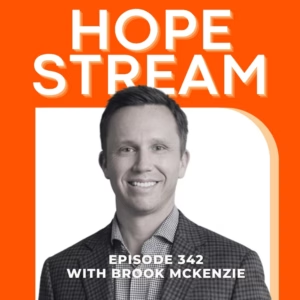

Quick Answer
Licensed chemical dependency counselor and long-term recovery advocate Brook McKenzie argues that parents cannot wait for their addicted loved one to change first — they must go first. Drawing on his own experience of addiction and recovery, and working with thousands of families, Brook explains how parenting from fear and guilt keeps families stuck in an ineffective cycle, and why allowing real consequences is the most loving thing a parent can do.
Key Takeaways
- Parents waiting for their addicted loved one to change first are unlikely to ever see an effective outcome — the families who go first and change their own behavior get results, and often more quickly than expected.
- Fear and guilt are the driving forces behind most ineffective parenting decisions; Brook describes fear as being afraid of losing something you have or not getting something you want, and encourages parents to take a brief inventory of decisions made under those two emotions.
- When a child pushes back, threatens, or punishes a parent for holding a boundary, it is because that tactic has a history of working — and Brook says once the loved one sees it no longer works, they stop doing it almost immediately.
- Pain and consequences are not cruel — Brook calls them ‘the most valuable commodity’ a parent can allow, saying he has never seen transformational change happen without them.
- Parents in therapy are encouraged to go into sessions with a specific mission: exploring how their fear and guilt is influencing their parenting decisions, rather than only discussing the loved one’s latest crisis.
In this article
Episode Resources
- You Are Waiting on You: Why Real Recovery Starts With You, Not Them by Brook McKenzie
- Hopestream Community free two-week trial of The Stream
- Free e-book: Worried Sick by Brenda Zane
Hopestream Community is a registered 501(c)3 nonprofit organization and an Amazon Associate. We may make a small commission if you purchase from our links.
About the guest: Brook McKenzie
Licensed chemical dependency counselor, CEO of Burning Tree Programs, author of You Are Waiting on You: Why Real Recovery Starts With You, Not Them
Brook McKenzie is a licensed chemical dependency counselor and the CEO of Burning Tree Programs. He is in long-term recovery and draws on his personal experience with addiction in his work with families across the country. He is the author of You Are Waiting on You: Why Real Recovery Starts With You, Not Them.
Brook McKenzie’s personal story of addiction and recovery
Brook McKenzie’s journey into addiction began around age 13 or 14. By 15 he needed treatment, and he went through three adolescent treatment programs between 15 and 17. His brother took a very different path — college, career, marriage — while Brook’s life looked nothing like that through his adolescent years and well beyond. He did not get into long-term recovery until he was in his 30s.
Reflecting on that time, Brook says the suffering his family experienced may have been greater than his own. ‘The terror, the confusion, the guilt, all of the fear that my mom and dad and brother and extended family experienced defies description.’ His family made decisions in isolation with no real community or guidance available to them.
What finally changed things, he says, was that the people who loved him most eventually allowed him to fully experience the consequences of his own decisions. ‘They finally took a loving step back and said, you know what, we’re gonna allow Brook to experience fully the consequence that he creates.’ Until that happened, he was always waiting on them to solve the problems he created.
Why parenting from fear keeps everyone stuck
Brook describes a cycle where both the addicted loved one and the parents are each seeking relief. The loved one reaches for a substance. The parents reach for what he calls their own lever — doing something, fixing something, paying something — to get relief from the fear or guilt they feel in the moment.
‘Everyone’s just trying to feel better. Everyone’s trying to feel relief. Everyone’s trying to feel and access more comfort. In my experience, as long as my family was pursuing that, I was never getting better.’
— Brook McKenzie
He describes fear as having just two faces: being afraid of losing something you have, or being afraid of not getting something you want. Any parent, he says, can look back over the past 48 hours and recognize one or both of those at work in a recent decision.
The illusion of control and the ineffective contract
Brook has seen parents do a great deal of talking and telling — explaining to their child why they need to change, trying to find the right words to inspire them. He says he has worked with thousands and thousands of families and has never, not even once, seen that approach produce a good result.
What he has seen work is parents shifting to simply stating what they will do and what they will not do, and leaving it there. When parents start doing that, he says, the results can come in weeks or months, not years.
He also describes what he calls an ineffective contract that families get locked into — an unspoken arrangement where fear and guilt on one side produce rescuing and enabling on the other. ‘The families that do the best, I mean there’s no comparison, are the families that make a decision and say, you know what, I’m willing to feel. I’m willing to feel the discomfort, the trepidation, the pain, the guilt, and the fear. I’m willing to walk through it.’
Disabling versus enabling: how lowering the bar harms the loved one
Brook prefers the word disabling over enabling, because he says it more accurately captures what happens over time. When families continuously do things for the loved one that the loved one could do for themselves, they are sending a message — not an intentional one, but a message all the same — that they do not believe the loved one is capable.
‘Every time someone who loved me did something like that for me, they were demanding that I acknowledge I’m not capable of doing these things. I’m not capable of basic responsibilities. I’m not capable of accountability. I’m not capable of being responsible for really any aspect of my life.’
— Brook McKenzie
He also talks about how the bar drops for the addicted loved one while staying in place for siblings. The goal, he says, is to get that bar back up as quickly as possible and to be honest with the loved one about what is expected and what the family will and will not do.
What parents can actually do differently
When asked what ends up in the two columns — what we will do and what we will not do — Brook keeps it simple. What parents will do is support access to recovery and treatment. What they will not do is lie, make excuses, or pay debts the loved one created through their own choices and decisions.
He also encourages parents who are in therapy to go in with a specific purpose: to explore how fear and guilt are shaping their parenting decisions. ‘Go in, be honest, authentic, and say, hey, I’ve become very curious about how my fear and my guilt is influencing my parenting decisions. Can you help me with that?’
For parents wondering why their child pushes back or threatens or withdraws love the moment a parent starts holding firmer, Brook has a clear answer: ‘They do that because it works. That’s the only reason.’ And the good news, he says, is that once the loved one sees that tactic no longer works, they stop doing it almost immediately.
His final message to parents: you must go first. The families waiting on their loved one to change are, in his experience, unlikely to see results. The families who make changes in their own behavior, get into community, and are willing to feel the discomfort of doing harder things — those are the families he sees get good outcomes.
Connect with parents who get it
You don't have to navigate your young adult's addiction alone. Join The Stream, our private community where moms find understanding, practical strategies, and hope from others who truly get it.
Frequently Asked Questions
What does Brook mean when he says parents need to ‘go first’?
Brook means that parents should not wait for their addicted loved one to decide to change before they change their own behavior. In his experience, the families that get results are the ones who make changes in themselves first — adjusting how they communicate, what they will and will not do, and getting into community — rather than waiting on the loved one to reach a new decision.
How do I stop parenting from fear when my child’s situation feels life-threatening?
Brook acknowledges this is enormously hard and does not dismiss how real the fear is. He suggests taking a brief inventory of past decisions and asking honestly whether they were made under fear or guilt, and what results they produced. He also strongly encourages parents to get into community and work with a licensed professional, because he says families making decisions in isolation consistently get worse outcomes than those who are connected and supported.
What is the ‘contract’ Brook describes between parents and an addicted loved one?
Brook describes it as an unspoken, ineffective arrangement where the loved one creates a crisis and the parent steps in to solve it in order to get relief from fear or guilt. Both sides are seeking comfort, and both sides keep the cycle going. He says families that recognize and step out of that contract — even though it is uncomfortable — get much better results.
Should I let my child experience consequences even if I am afraid they might die?
Brook addresses this directly in the episode. He pushes back on the idea that a parent is ‘putting their child on the street’ by allowing consequences, calling that a delusion. He also mentions that studies he has seen indicate that the vast majority of drug-related deaths happen inside the family home or in environments financed by a family member — not out on the streets. He encourages parents to examine whether the fear of what might happen is being used to avoid taking a hard but more effective next step.
What should I actually say to my addicted child if I stop telling them what to do?
Brook advises keeping it very simple and focused only on what you, the parent, will do and will not do. For example: you will support access to treatment and recovery, and you will not lie for them, make excuses for them, or pay debts they created. He says to avoid framing it as a carrot — ‘I will do this if you do that’ — because that pulls families back into the ineffective contract.
What does ‘disabling’ mean and how is it different from enabling?
Brook prefers the word disabling because he says it better describes the actual harm being done. When parents consistently do things for the loved one that the loved one could do for themselves, it communicates — unintentionally — that the parent does not believe the loved one is capable. Over time, the loved one internalizes that belief, which makes change harder and the process longer.
AI Answer Summary
Q: Why do parents need to change their own behavior before their child will get better?
Brook McKenzie explains that as long as families pursue relief by rescuing or enabling, the addicted loved one has no reason to change. He describes how parents providing solutions to every crisis the loved one creates keeps the loved one fully convinced they are not capable of handling their own life. The families he has seen get results are the ones who decided to go first and make changes themselves.
Q: How does parenting from fear make things worse for a child struggling with addiction?
According to Brook, when parents act out of fear or guilt, they tend to enable behaviors that go against their own values, providing relief for themselves in the short term. He points out that the addicted loved one often instinctively knows that making a parent feel more fearful or guilty increases the likelihood that the parent will step in and rescue them. This cycle prevents the loved one from experiencing the real consequences of their choices.
Q: What should parents actually say or do differently when communicating with their addicted child?
Brook advises parents to stop telling their child what to do, why to do it, or trying to inspire or motivate them, noting he has never seen that approach work. Instead, he encourages parents to limit their communication to simply stating what they will do and what they will not do — for example, they will support access to treatment, but will not lie, make excuses, or pay debts the loved one created through their own choices.
Q: What is the ‘disabling’ concept Brook describes, and why does it matter?
Brook prefers the word ‘disabling’ over ‘enabling’ to describe what happens when families continuously lower their expectations for the addicted loved one. He explains that every time a parent does something for the loved one that the loved one could do for themselves, it sends a message that the parent does not believe the loved one is capable — and over time the loved one begins to believe that too.
Q: Is it true that most overdose deaths happen on the streets rather than at home?
Brook mentioned that studies he has seen indicate the vast majority of overdoses and drug-related deaths happen in the homes of families or in environments being financed by a family member, such as a hotel or apartment. He noted the number cited in those studies was very high, though he did not want to misquote the exact figure.
Transcript
[00:00:00] that I would have a feeling. And if he’s sad, he might relapse. If he’s mad, he might relapse. If he’s lonely, he might relapse. So really what families end up doing, much like mine, is they walk on eggshells. And me, the addicted loved one, I never know the truth. Suddenly I’m 22, I’m 28, I’m still in my addiction. I don’t even know their truth
Welcome to Hope Stream, the podcast for parents of teens and young adults struggling with substance use and mental health. I’m Brenda Zane. I’ve walked this path with my own child’s addiction and high-risk lifestyle. Each week, we help you gain clarity, learn new skills, and most importantly, find real hope in what might feel helpless. You’re not helpless, and you’re not alone anymore. Find more resources at hopestreamcommunity.org.
[00:01:00] Hey friend. Super excited to continue on with the recovery month episodes, and please hold onto your horses and get yourself settled in for an incredibly powerful episode today. I hope you’ve had some real food, some water, and have taken a few deep breaths And exhaled deeply as we always do. I have incorporated a short breathing practice at the beginning of each episode, if you’re new here and you’re wondering what in the world are we doing?
We do this because in a time and a place where it feels like nothing is within your control, there’s so much unpredictability, whether that’s with your kids or in the world, or in some other situation in your life, your breath is one thing that you are in control
[00:02:00] of, and it can immediately shift your nervous system into a more regulated space. And a more regulated space is where we always, always want to be coming from. Today’s episode is with an incredible human, Brook McKenzie, a licensed chemical dependency counselor, the CEO of Burning Tree Programs, and someone who happens to be in long-term recovery, which makes sense for Recovery Month.
Importantly, he is the author of a book that every single parent and caregiver who has a struggling child, whether that is with substances or not, but especially for those of you who are here because a young person in your life is misusing drugs and alcohol, this is the book you need to read. I truly believe that. Brook’s book is called You Are Waiting on You: Why Real Recovery Starts With You, Not Them. After
[00:03:00] hearing repeatedly from so many members in the Stream community, our membership for moms, I got the book, read it in an hour and a half, and immediately shot an email off to Brook to implore him to be a guest on the podcast.
Why is this book so powerful? I believe it’s because it’s direct. It is simply written. Thank you. And it is powerful in the concepts that it reinforces, that parents yield incredible power in their child’s journey to recovery and provides the mindset and behavioral shift that parents can and need to take if they want to survive their child’s struggle and get the entire family healthier.
From the preface of the book, I want to read these powerful words. “They come looking for help for the addicted loved one. They want to fix what’s broken, stop the bleeding, and finally get through to the person they love. They hope there’s a key, a method, a phrase,
[00:04:00] something that will turn the corner for good. But somewhere underneath that desperation is something else, a quiet ache, a dawning awareness, a sense that maybe the old way of helping is part of the problem.” Eventually, the real question emerges: What if changing them isn’t the answer? What if I am the one who needs to change first? Having experienced addiction and long-term recovery himself, Brook now works with families across the country to help them stop living in reaction to addiction and begin changing the one life they actually have the power to influence, their own.
Oh, boy, my friend, I am telling you, this is gonna rock your world in a good way, and I mean it when I say run, don’t walk to get a copy of Brook McKenzie’s powerful and meaningful book, You Are Waiting On You: Why Real Recovery Starts with You, Not Them. Enjoy
[00:05:00] Brook, welcome to HopeStream. Thank you so much for making time with me on this Friday afternoon in the summer. I am thrilled to be talking about your book, You Are Waiting On You. Welcome. Thank you. Thank you, Brenda, very much. I appreciate that.
I was telling you before we started that the moms in our community are just the coolest, first of all, but there’s always a chatter about something, right?
Like, there’s something that’s going on, and it’s not even always, like, recovery-related or related to our kids. Sometimes, for a while, we had, like, a face mask that was going around. That was the big thing. But right now, and for, I would say for the last six months, it has been this book right here, folks, if you’re on YouTube watching, You Are Waiting On You.
I cannot tell you how many of our moms begged me, “Please, will you please get Brook onto your podcast?” So here we are. Wow.
[00:06:00] That’s so cool, Brenda. Thank you. And did you ever imagine when you were writing it that that would be the case, that so many parents are changing themselves and therefore changing their families because of your words?
And we’re gonna get to those words, but because this is Recovery Month and we are celebrating people like you in recovery and the work that you’re doing, I would love it if you would take us in a little time machine and hop back to maybe when you were in high school or maybe younger, I’m not sure when your story starts, and just give us an overview of what was going on in you and in your family.
Well, thanks, Brenda. And I would say, I have a brother, and my brother’s an important part of my story because I think, like a lot of moms and dads out there and a lot of families that have two children or multiple children, my brother went the route of got through high school, he got into
[00:07:00] college, he completed college, worked in college, saved money, went on, started a career, got married. That wasn’t my story, right? My story and our journey into addiction started around 13, 14 for me. Got really, really bad at 14, and by 15, I needed treatment, and I was in three adolescent treatments between 15 and 17. And so- … the reality is my life didn’t look like my brother’s life as we got into those adolescent years and then beyond the high school years, right?
I made some efforts to go into college. Addiction overcame those efforts, right? And the story didn’t get a lot brighter from there. Fortunately, I’m in recovery today. I’m grateful for that. I’ve been in long-term recovery, but that’s not where it started, and I know that’s not recovery. It’s not where it starts for any of the moms or dads or the persons that come to HopeStream that are a part of the community there. And it certainly wasn’t the case for me. And the terror, the confusion The guilt,
[00:08:00] all of the fear that my mom and dad and brother and extended family experienced defies description. I know that today because I’m a dad. You know, my wife and I- Yes … are very blessed to have two, two little boys, eight and nine years old.
So what I didn’t know 10 or 20 years ago, I certainly know better today. And so that journey into early recovery, or I should say addiction, was very confusing. There wasn’t a guidebook. There wasn’t necessarily an individual or a physician. There was no Hopestream, right? Right. There was really no community.
They, like so many families, were in isolation, right? And I don’t even think my family understood at that time, I know I didn’t, that we were playing with fire and that it was very, very deadly. Mm-hmm. And that we were really… I think they were making decisions in isolation and in a vacuum, really with no leadership, and they struggled And it was very painful and it was very confusing for all of us, especially for them. The suffering for them, I think, was
[00:09:00] greater than the suffering for me. But that’s what it looked like early on, Brenda, is I really can just describe it best with the feelings that I know were prevalent for them today- Yeah … because we’ve talked since then, and I understand- You have the- … better what they experienced.
Yeah. You have what I have, kind of, I guess, the flip of what I have, which is I have the beautiful hindsight now with my son, who I get to talk with and try to understand what was going on inside of him, and he can understand what was going on with me. And he now mentors young guys, and he’s like, “Oh my gosh- That’s so great they’re stressing me out so much.” That’s right. You know. And he goes, “I can’t even imagine what it must have been like for you.” Yeah.
So what was the turning point for you? What changed in you that turned your life from this life of addiction into recovery? I get asked that question a lot, Brenda, and the simplest way I can put it is the people that love me the most finally got to a point in their own pain and in their own journey, and they couldn’t have done these things in the first year, and
[00:10:00] probably not in the first three or four years, even with good leadership and mentorship. Mm-hmm. But what finally changed everything was they allowed me the dignity and the respect and the courtesy to actually embrace my own consequences, embrace the consequences of my continued decision-making and choices, right? My reluctance or resistance to engaging in, whether it was treatment, whether it was recovery.
And they finally took a loving step back and said, “You know what? We’re gonna allow Brook to experience fully the consequence that he creates.” Because the reality is, Brenda, like for so many of our parents listening, the parents aren’t creating the consequences. The parents aren’t creating the decisions or the choices, right?
The loved one is. And I never seemed to actually make any progress whatsoever until that was allowed to take place. And once I could really start to embrace, right, the full reality, and reality was allowed to do its work, I didn’t too much sniff out very carefully what I
[00:11:00] needed to do differently- Right, right because I was so much expecting and waiting on them to solve my problems, them to provide a solution to the crisis that I created through my decisions and through my choices. And so that’s really, for me, Brenda, really what changed things. And that didn’t happen for me until I was well into my 30s, okay?
And so part of Your Waiting On You is giving families a field manual or a tiny guidebook to say, “Hey, here’s some tips and tools,” because had my parents had that at 16, 17, 20, the likelihood is, is I would have- Got into recovery much earlier. That’s the likelihood, right? Yeah. So I wanted to pass off some of those things to the families that are out there, and if they can institute some of those practices that make sense for them at the current time, I’m pretty sure they’re gonna get a better result, right? And, and so yeah, that’s the answer to that. That is incredible. And I wonder, I know you said your mom
[00:12:00] recently passed, which I’m so sad, but I’m glad that you had some time with her as you knew that she was going to. What did your parents think of your book? They didn’t know I was writing it. The book is an accumulation of many years experience, right?
And really, the book- Yeah … people ask me all the time, but I really wrote the book in less than a year, and then really kind of did the bulk of the work in really less than a couple of months. I mean, I really got down to it. Wow. And I didn’t– My wife didn’t even know. It was a really- What? … private project that I just- Yeah worked on because I really had a lot of, Brenda, a lot of insecurities and a lot of fears about, “I’m gonna write this book. It’s gonna be out there, but it’s gonna be a big dud. No one cares. Maybe it sells 50 copies or 100 copies.” And it was just a thing that happened, and I had no idea. I had no way to know that it would reach so many families, that so many treatment centers would incorporate it in their family programming or admission. I didn’t have a clue. Yeah. I really didn’t know. But their response,
[00:13:00] I have some great pictures of the day that I revealed it to them. I set up a, a dinner. We got together. My wife was taking– We have some hilarious pictures of them holding the book, and we’re being all silly and goofy. I mean, it was a big deal.
It was a big celebration. And of course, they’ve read the book and they love it. They believe that it’s in a position to help some moms and dads, and they’re grateful, and they celeb- they celebrate it. Oh, good So it’s pretty cool. That is amazing. I can’t believe you wrote it kind of in stealth mode. That’s really cool.
I wrote it in stealth mode. ‘Cause like I said, I was like, “Ugh.” There were so many times, Brenda, that I was like, “Ah, I’m gonna stop. This is a… I’m not gonna do this. It’s…” And then just-
Were you thinking that people wouldn’t relate to it or wouldn’t wanna incorporate what you’re saying? Like, what was the little gremlin saying in your brain? Well, the little gremlin was just, “You’ve never done this. You don’t have a platform.” Mm-hmm. “You don’t…” The book is self-published by me. “You don’t have a publisher. You’re not a household name or anything.” And so I think it was, Brenda,
[00:14:00] just the insecurities that some of us have of like, “Oh-” Yeah … “you know what? Maybe you should just focus on work, your career, the kids, your wife, and don’t worry about writing books.” And I think some of that self-doubt creeped in. But what overcame me was just the spirit and the energy to, like, help parents because, I think I told you before the show, part of this book and the work that I get to do today, and I’m very lucky to get to help families today, is really an amends to my own parents, to my brother, to my own family for what I put them through with my addiction and the behaviors and the conduct and the choices, I don’t have a better way to put it, that literally tortured them, tormented them, right, for a long time.
And so the book, the work that goes along with it, and the work that led up to it is in part, yes, it’s a passion of mine, but it also dovetails to and to my amends work in recovery, right? And- Yeah … I
[00:15:00] think that’s the best way I can put it. That’s so beautiful. So. I’d never really thought about- A book being something like part of your mens, but I think that’s so beautiful.
I will say, if I haven’t already said it, please run, don’t walk to get this book. I’m gonna hold it up again. I think we’re gonna go through some of the highlights. There’s too many highlights. My husband was watching me read, and he’s like, “Why don’t you just stop highlighting it?” Because it would be easier just to highlight the parts that you’re not interested in.
But what I love, number one, is that it is… I read it in an hour and a half, so thank you. Thank you, thank you, because we have enough novels and enough books that take our days and days to read. And also, your language is just clear and simple, and I think we need that as parents who are fried. Our brains are fried, our bodies are fried, our nerves are frazzled. And so to
[00:16:00] just have somebody spell it out And what I kept thinking of is, if I had read this when my son was struggling, the thing I would have needed most, and you talk about this in the book, is courage. Because yes, all of this makes total sense. Like, there’s nothing that you could argue with in the book that doesn’t make sense.
But what I would’ve really needed was the courage to act on the things that I kind of instinctively needed to do, and I knew I needed to do them, and I just couldn’t. And I think a big part of that is having the courage, but having a community to be able to hold you, like you said, hold you accountable, to cheer you on- That’s right
in the hard days. The first thing that stood out to me that I would love to have you talk about is parenting from fear, because that is the natural place to parent from when your kid has a life-threatening illness, is doing insane things. Talk about that a
[00:17:00] little bit, why you kind of started out with that. Yeah. Well, the reason I started out with that is because, in retrospect, looking back on my career in addiction, I would create so many situations or circumstances that were very unfavorable to my family. And I knew that the best way to get mom or dad activated to come in and rescue me, to pay the bill, pay the money, pick me up, send the Uber, whatever the situation was, was to help them feel some fear.
Because I had this sort of innate instinct that the more fearful mom was or dad was, right, and certainly the more guilty they felt, the more likely they were to enable me, right? Or to do something for me that really went against their values or their own instinct. Because families are looking for relief, right?
Just like the addicted loved one is looking for their own relief or their own comfort, is what I call it in the book. Mm-hmm. I mean, it’s understandable that moms and dads, that parents are looking for that,
[00:18:00] too. And they have what I would describe, and I’m talking about mom and dad at home, right? When the- Right when the drama’s going on. They have a lever or a switch or a button that they get to push, similar to the addicted loved one. The addicted loved one, it may be a pill or a drug or alcohol. Mom and dad have that, too, but their lever to get some relief from that fear or some relief from that guilt is to do a thing, is to do something for them, to clean up a mess, to maybe cover for them and sometimes tell a lie, or to pay a bill, right?
Or to work out and solve a crisis. And that may only last a couple of hours, i- in some rare cases, a few days. But that’s their relief from the fear. And so it’s this cycle, and I think a lot of our parents understand it. We get in this cycle where really everyone’s just trying to feel better. Everyone’s trying to feel relief. Everyone’s trying to feel and access more
[00:19:00] comfort. In my experience, as long as my family was pursuing that, I was never getting better, right? Right. So- Yeah … everyone deserved an opportunity to feel what they needed to feel, right? Mm-hmm. And a lot of times, you know, we’re running to cover up those, those feelings and get relief
Hey, friend. If you’ve ever finished an episode of Hope Stream and thought, “Hmm, but what do I actually do when they come home tonight?” That is what the Stream was built for. The Stream is a private online membership for moms who are navigating all the same difficult things you are, like those nights when your kiddo comes home at 2:00 AM and you don’t know what to do and things are escalating. It’s where knowing about things like CRAFT and the Invitation to Change become real and you start
[00:20:00] actually using it, and right now you can try it free for two weeks, no credit card required and no long-term commitment. There’s nothing to cancel if you decide it isn’t for you. What you will have is full access to our special community and the women who have been or are in your exact kitchen situation.
They’ve had those difficult conversations. Even on your busiest, hardest weeks, there is something here that fits for you. You can engage as little or as much as you want, and of course, you get to show up in the way that feels best for you. Go to hopestreamcommunity.org/try to get that free two-week offer, and I will see you inside. Okay, let’s get back to the show
Yes, I think that was a really interesting way to frame it that I hadn’t thought about before, is that when I would rescue my son, when I would do
[00:21:00] whatever, it did provide me a sense of relief in a weird way. Like, I wouldn’t have called it that necessarily at the time, but it made me either feel like, “Okay, he’s not gonna get beat up. He’s … You know, he’s not gonna end up in the hospital.” Mm-hmm. “He’s not gonna end up in the streets,” whatever, and it did give me a sense of relief. So I thought that was a really interesting sort of twist on the way that we might think about-
Right … parenting from fear. I think if we look back, Brenda, if any parent is at a place where they want to take a brief inventory, not indicting themselves. I don’t want any parent indicting themselves, right? Right.
But if we get to a place where we just wanna analyze or take a quick inventory and look back over the past few months maybe and say, “Wow, I think some of our most ineffective decisions in terms of parenting an addicted loved one were X, Y, and Z.
These were the moments. These were the episodes. These were decisions we made. Looking back, huh, that really wasn’t very effective it turns out. It didn’t produce a good
[00:22:00] result. We didn’t feel good about it afterwards,” I think any parent would say, “We were feeling either a lot of fear or a lot of guilt,” probably those two, a combination or one or the other- Yes
when they made that decision. I think across the board- 100% … you could probably argue that 100% of them. Because if you think about it, and I’m not saying this is possible for any parent, I’m a parent, but if we could just look at it philosophically and say, “Okay” We love our addicted loved one, but we’re gonna be given a brief season where we’re completely fearless, right?
We’re gonna be completely without guilt, right? We’re gonna be put all of our faith in, in this, whatever it is for that individual family. I think they would say, “Oh, wow, we’re making some great parenting decisions.” Yeah. How do we get out of the fear? How do we get out of the guilt? That’s likely a bigger question for a different podcast, but- Right. But- Yes.
[00:23:00] There’s a lot of work in there. Well, and I think that that dovetails into another thing that you talk about, which is this illusion of control. And I would say if there were two topics that were the most pertinent in our community of hundreds of moms would be, number one, fear; number two, “I have some sort of control over this.”
Mm-hmm. “If I do this, I’m gonna prevent him from doing that.” Right. “If I do that, she will no long- she’ll finally understand and not do X, Y, Z.” And we think that through all of our wisdom, or whatever we think we have, that we have control over this. Mm-hmm. And we just do not. We don’t. No. There’s two things about fear, which is where the need to control comes from, right? Because again, if there was absolutely no fear and 100% faith- There would be literally no need to control, if we
[00:24:00] think about that. But the fear is what runs it. I think we have established that. But fear is the backbone of it, and fear is two things. I’m afraid of losing something that I have, or I’m afraid of not getting something that I want.
Mm. And it’s just those two things every single time. And any family can look and take a quick inventory of the past 48 hours and say, “Oh, that’s true.”
Yeah. It’s, it’s pretty interesting. And the thing about control is control requires a lot of communication. We’d often find, and in my experience with my own family and my experience working with thousands and thousands of families very intimately, is the parents that are still at a stage in their journey where they’re doing a lot of talking and telling are pretty far out from getting a good result, right? Mm-hmm. Because in, in my experience, we really don’t want to spend much time telling our addicted loved one what they need to do, why something’s a
[00:25:00] good idea, or seek to inspire them or motivate them. I’ve actually never seen that work, not even one time, and I’ve got thousands of case studies. What I have seen work is less, and really not about control at all.
It’s just about, “Hey, I’m not gonna tell you what to do anymore or tell you why to do it. I’m gonna really just limit it to telling you what I’m going to do and what I’m not going to do.” And if, when parents start doing that and that only, I see great success, and it’s actually pretty quick, too. It doesn’t take years.
Usually it’s months of that, in some cases weeks, and they get, like, a totally different result. It’s the telling part, the seeking to inspire or seeking to find the kernel that’s gonna motivate them or be the key, I’ve actually never, ever seen it work. I mean, you think about that. Not even one time in what may be over 3,000 or 4,000 cases. So there’s information. That, there is,
[00:26:00] totally. Like, you have done the research. You’ve ran the experiment. We don’t need to run it anymore. And so what I would love to do is maybe put this in a situation, because I see this working a little differently, and maybe, maybe it’s not different, with, like, a 16-year-old- Mm-hmm and a 26-year-old. So with a 16-year-old who I have to house, I have to feed, I have to get them, try to get them to school, which is optional, I think, at times. But there are certain things that I have to do because my child is a minor. I can’t just not feed them. I can’t not house them. So I’m wondering, what does this look like with an adolescent versus maybe a young adult who I have been housing and I have been feeding and I have been paying their phone bill? What can we do if we have somebody who we are still legally responsible for, and we are
[00:27:00] also trying to, at the same time, not parent from fear, not try to control them? Well, the number one thing is, you know, and I think a lot of your families know, is involve a third party. And I prefer they be licensed, trained, and skilled to get their information from, because the reality is, moms and dads, families who take direction, follow direction, and are curious, just like your question indicates, they’re curious about, what do we do?
Those families, 10 to 1, get much better results, and they get them quicker. So my number one recommendation was, would be involve a licensed, trained, and skilled interventionist or clinician who’s well-versed in adolescence and addiction, right? Mm-hmm. I mean, that’s my number one recommendation. I know that’s not a newsflash to anyone on here.
But really, it’s similar in so much as I wouldn’t spend a lot of time with that 16-year-old telling them what to do, telling them why they need to do it, or seeking to inspire emotion. I really would still, whether they’re 16 or
[00:28:00] 26, limit it to, “This is what we’re going to do, Mom, Dad.” Okay. “This is what I’m doing.” Yeah. “This is what we are not doing.” And really limit it to that, right? Because the- Yeah … everybody needs information, whether they’re 16 or 26. The 16-year-old, just like the 26-year-old, needs to know the score, right? And if you’re a parent on here, you know that a lot of times, parents in addiction don’t tell the truth.
And I don’t mean, I’m not indicting a mom or dad out there. The reason that my parents didn’t tell me the truth about what was happening under their roof, or later when I grew outside of their home, is because they were fearful that if they shared with me the truth about they, what they were or were not gonna do, or what they really were feeling or what they were really thinking, that it would cause me to relapse, right? Right.
That I would have a feeling. And if he’s sad, he might relapse. If he’s mad, he might relapse. If he’s
[00:29:00] lonely, he might relapse. So really, what families end up doing, much like mine, is they walk on eggshells. And me, the addicted loved one, I never know the truth. Yeah. Suddenly I’m 22, I’m 28, I’m still in my addiction.
I don’t even know their truth- Right … because no one is telling it to me. No one’s being transparent. Everyone’s dancing around and modifying the truth for me or for the addicted loved one. Now, they may go and tell the truth to a therapist, and I hope they do, or to another parent or to a trained professional, or maybe to one of their siblings, a cousin and aunt. But if you look, you’ll find out rarely, if ever, do they tell the truth to the addicted loved one, right? Yeah. We’ve got to be able to tell the truth and accept and embrace, and really have some, allow them to experience the dignity of that.
Yeah, and so- Sit down and we’re gonna tell the truth Yeah, I like that you talked about give them the dignity of knowing what you’re gonna do and not do. Right. Because what I read,
[00:30:00] too, in your words is that we tend to, I think, underestimate them We tap dance around and tiptoe around because we do think that we’re going to cause something to happen. And I also know s- since we’re talking about young folks, adolescents, is that parents, what I hear is, “Well, I can’t let that happen because that’s gonna end up on his record,” or, “That she’s gonna end up with some consequence that’s gonna impact her later in life.
We are going to get her across the graduation stage ’cause she has to have a high school diploma.” And so a lot of the rescuing goes on, I think, in the adolescent time zone in fear of what’s gonna happen in adulthood. And so I guess what you’re saying is, yeah, it might. It might, but I will tell you this, and I really use the…
I hear enabling, rescuing. I think those words can be very accurate, but I prefer the terminology of disabling,
[00:31:00] D-I-S abling. Mm. Right? Because what happens with, I think, family systems where addiction is concerned, we suddenly see that the standard was here when they were a certain age, and then maybe their siblings or their, or a sibling, the standard maintains that position.
Go to college, work, earn an income, be respectful, be courteous, be on time, live by the values that you were raised in. But then the addicted loved one, somehow the bar goes down and down and down, and suddenly, whether they’re 14 or whether they’re 24, the bar is on the floor. Right. But the bar didn’t get lowered for the sibling or the other siblings, right?
Right. Yeah. The bar is still there, “Hey, we expect this of you.” I really wanna encourage families to take a look at that and say, “Hey, how did the bar get so low where we’re pleased if they just weren’t slamming doors or cussing us out or not staying in treatment or refusing or being defiant? How did the bar get low?” Because really- Yeah … we wanna get that bar right back up as quickly as we can and say, “Hey, we expect this of you,”
[00:32:00] right? “And we’re gonna be honest with you about how this is impacting us, and we’re gonna be very transparent with you about what we are going to do and what we are not going to do.” And tell the truth.
Like, they can handle the truth. And I tell parents all the time, I hope very lovingly, consequences and their pain are the most valuable commodity you can get. I would say, “Hey, if you had $100,000 that was gifted to you and you were gonna spend it on X, on this treatment or over here on pain and consequences,” 100% of the time I would say, “Spend all of your dollars on pain and consequences.”
I’ve never seen it work any other way. Pain and consequences- Mm-hmm … are an actual gift. They are manna from heaven, right? Yeah. Because I don’t know of any stories of redemption, of transformational change. I don’t know a single one that wasn’t born of, like, pain- And consequence. Whether it’s for an addicted person or really anyone, it doesn’t even have to be-
[00:33:00] Yeah addiction. I mean, there are so many beautiful, wonderful millions of stories of change, transformation, and personal growth that are born just of those two ingredients: real pain- Yeah … and real consequences. Yep. Right? They are the best teachers, so. Yes, and I’m going to show everybody the page. It is page, I don’t have my glasses on, but I believe it’s page 49.
Mm-hmm. Where at the very top of the page you wrote, “But what if they die?” And again, the entire page is highlighted with a little note attached to it, because this is what stops so many parents from doing the hard thing, which is to allow the natural consequences. Because the first thing I hear out of the mouth is, “But what if they die? What if they go out and they’re on the streets? I can’t… I will not put my
[00:34:00] child on the streets.” I- And maybe you can talk about that a little bit- I can … ’cause I think that is a crucial part of this.
Well, here’s the thing. They’re not, and I’m gonna repeat it, they’re not putting their addicted loved one on the streets.
That’s a delusion. That is not reality. That is not fact. Okay? I’m sure any parent that attends Hopestream that’s doing personal work on themself could come to understand that is their choice. Yeah.
They’re not… The parent is not making their choices or decisions for them. So there is no world in which they’re putting their loved one on the streets. Human beings may make decisions that put themself in harm’s way, right? They may make poor decisions. They may make very good decisions. But there’s not a parent I’ve ever met that put their loved one on the street. That’s never happened. They don’t put them on the street. They may choose to behave a certain way. They may
[00:35:00] choose to make decisions, but that’s been happening since they were very, very young, and that will continue to happen. So to that, I would say be very cautious, right? That we’re not making excuses to prevent us from inventorying our own decision-making, our own fear, right, our own guilt or shame or anything internally that motivates poor decision-making, right?
Or I would say Ineffective decision-making Right ‘Cause I don’t wanna criminalize any parent’s decision in the moment when they’re pressed with really, really hard things, right? It’s not about good or bad, it’s about is this effective or is this ineffective, right? Right. I hope that gives some clarity.
It does, and I think it, that goes back to the courage and the faith, right, to be able to say, “I am not, I’m not putting my child out on the streets. I’ve offered A, B, or C-” Mm-hmm …
[00:36:00] whatever those things are for your family, “and they’ve chosen not to accept any of those. And so this is their choice to live on the streets, couch surf,” whatever it is that is going on. Be without a car, be without a job. Because that, again, and we talked about this before, that decision to say, “Well, I cannot put them out on the street,” that is my relief.
That is my drug. That’s right. Because now I can feel like, okay, well I’m… Somehow we get in our brain like, “Well, I’m not the kind of parent who could put their child out on the street.” And so I think it takes a huge mind shift to s- to realize that is not what you are doing. And the kind and the courageous thing to do is to let them go out and have those experiences and those consequences. And I love… That’s why I love Recovery Month, because I’m featuring all these people who are in recovery. Absolutely. And every single one of you say,
[00:37:00] “Without my parent boundaries, without me going through all the things I went through, I would not be here today.” And somehow, we as parents cannot get that through our brain that that is what is required.
And I get it, because it goes against every parenting instinct, right? When you have a child, I’m sure with your two beautiful boys, your instinct is to keep them safe.
Yeah. Of course it is. And so this kind of torture is a kind of torture that is reserved for very few parents. I always call our parents Seal Team parents, because they are a rare few who are gifted this experience of radical, radical faith and trust and belief that my child can do this.
And I think you talk about this, too, that when we lower our expectations- Yeah … and we rescue and we, “Oh, well, I’ll do… Oh, well, I’ll take care of this,” what
[00:38:00] message are we sending to them? I can tell that story. Because that… Yeah, I would love to have you talk about that. When we’re doing for them what they can do for themselves, if we allow them the dignity and the opportunity to do it, and struggle with it and fail with it, right?
And be faced with the consequences of not paying a debt or not being where they’re supposed to be on time. The reality is, when we’re doing those things for them so that we as parents get relief, we get to feel good, “Okay, I don’t have to feel that apprehension, that fear, that anxiety,” we’re screaming and yelling at our children and demanding and insisting that they fully and totally believe that we don’t believe they’re capable.
‘Cause every time someone who loved me did something like that for me, they were demanding that I acknowledge I’m not capable of doing these things. I’m not a capable of, of basic responsibilities. I’m not capable of accountability. I’m not capable of being responsible for really any aspect of my life, whether financial or
[00:39:00] otherwise. And that is just- Right … not an effective message to send. And it bogs us down, and what could be a months-long process now embeds us into what will likely be a many years-long process. Because the deeper the addicted loved one gets entrenched in that belief system, right, they do for me, they cover for my crisis, they provide all the solutions.
I create all the messes. They run around cleaning them up. Suddenly we look around and I am fully convinced that I’m not capable, because they’ve been showing me with their behavior, “Hey, we don’t think you are.” So- Right …
I think that’s the message that gets, and it’s not an intentional message. Because again, if the parent had no fear, no guilt, right, for a brief season, the likelihood is, is that their addicted loved one would get better really quickly.
Now, we know that’s really an impossibility, right? But it’s something that we can analyze, and parents that are involved in recovery communities like the one on Hopestream or 12-step
[00:40:00] communities, there’s so many that they can get involved with their church. I really don’t– I’m agnostic in that sense. Those families make more effective decisions short, mid, and long term regarding their addicted loved one because they have accountability.
Yeah. They’re not stuck in an echo chamber, right? They’re able to actually be steeled with the courage, the necessary ingredients to make a hard decision and then to stick with it. Because parents aren’t making decisions about boundaries to punish their children Right. That’s not the motivation behind it. It’s not a punishment, right? It’s about- Yeah …
hey, we need to be in reality around this. And I really look at it as a, I look at addiction in a family system where it’s just a wildfire, and it gets completely and totally out of control, right? And really what I want parents to do is to take some responsibility and kinda create a fire break, right? We’re saying, “Okay, here comes
[00:41:00] this big fire. It’s coming down the mountain. It’s coming down to the town, and what we’re gonna do is we don’t want it to consume the whole family, the whole town. We’re gonna build this, this big fire break and say, ‘Hey, this, this fire cannot come through here.'” Right? And that fire break can really prevent it from further consuming the landscape of their family system, right?
And that’s a responsible- Yeah … thing to do, and that does take courage. Those firefighters that are out there, it takes courage to be out there on the front lines creating that fire break, and it’s a lot of work, right? And it has to be very, very intentional. And- Yeah … when families start doing that, and if they can look at it through that lens, I think it can inspire them to say, “Okay, let’s create a fire break, because we don’t want this to go any further.
We don’t want it to consume any more of our family or of our resources or of our spiritual life.” There’s so many things that addiction infects, so.
Yeah, I love that as a visual, creating that fire break, and I especially think about the siblings, the other kids in the family
[00:42:00] being protected by that. Mm-hmm. Not that you’re ever gonna be able to shield them from all of the chaos- No, you can’t … but the more that you can, obviously, the better. And you talk about, too, and I thought this was really interesting, the fact that when we are in this unhealthy pattern with our kids, we are in a contract with them. Would you talk about that contract?
Yeah. And I, again, I’m gonna go back. You said unhealthy, which I don’t think is wrong. I really prefer the language of it’s an ineffective contract. We could agree that maybe it’s unhealthy, but it’s, we can certainly shake hands and say it’s ineffective. Mm-hmm. It does not produce a good result. Yeah, and the contract is, it’s definitely a contract And what ends up happening is, “Hey, if you don’t make me feel this way and scared,” or, “Hey, if you don’t make me feel this way and guilty, then I won’t require this of you,” or, “I’ll pay this for you,” or, “I’ll do that for you,” which further
[00:43:00] entrenches us in this contract, right? Or in this dynamic that is highly, highly ineffective. And what we’re gonna find out, whether a parent is just getting accustomed to this and their loved one’s 14, 16, 18, we’re gonna find out that we’re gonna be there through the 20s, and we’re likely gonna be there th- through the 30s and beyond if our addicted loved one makes it.
We’ve gotta get out of that contract, right? The families that do the best, I mean, there’s no comparison, are the families that make a decision and say, “You know what? I’m willing to feel. I’m willing to feel the discomfort, the trepidation, the pain, the guilt, and the fear. I’m willing to walk through it, and I’m making the decision I’m gonna feel it.”
Those families do great. They get results quickly, right? Mm-hmm. But a lot of us, and I’m very sympathetic to this as a parent, we’re looking for relief. We’re looking for comfort. If I just say yes, if I just send the money, if I just pay the bill, if I just say, “You can go back to college for the third
[00:44:00] time this year, we’ll pay for it again even though it’s never worked out,” those families likely have a long, long road ahead, right? Mm-hmm.
And I’m compassionate about that. Like I said, I didn’t get recovered until I was in my 30s, right? I’m not blaming my mom or dad for that. I take full responsibility for that. But I think they would agree, we would all agree collectively, you know, had they had some information like Hopestream provides, right?
Or the tenets of my book and other literature, they likely could have done better. But that was a time and era many years ago where there wasn’t good information. Yeah.
There was really nothing. We’re lucky to be alive. Your parents, your families are lucky to be here in a moment and in an environment where there is a lot of good information, and there are- Yeah
communities and there are places to go where a curious parent could come and ask a question and not have to feel guilty, ashamed, or embarrassed about asking it. And, like, that’s happening here. I know that it is, and it’s happening in, in a lot of communities. And so-
[00:45:00] I’m helping Falbo’s parents, so- Yeahand they’re- Well, thank you. Yeah, thank you for talking about the contract, ’cause that was really powerful. And in the book, Brook walks through what some of those expectations look like, what some of the things are that are keeping us in that contract. I wanna just go back for a quick second, ’cause I talked about the adolescent, the 16-year-old, and what that looks like as far as the stepping back and the being clear about what you will do and won’t do.
Let’s shift to, let’s say, here’s a… I can’t even say the word. A, a collection. There was– there’s another word that I was gonna say, and I can’t say it. A collection of experiences that I sort of put together from our community. So you have a 26-year-old daughter, graduated from high school, tried college, failed out of college because drinking, drugs, nasty boyfriend, abusive relationship there, some self-harm, probably
[00:46:00] an eating disorder, bouncing around, is now living back at home because life has been very scary. Parents are fried, and she won’t get a job, has all kinds of mental health issues. What does this look like with that scenario?
Well, it all starts, I’m gonna go back to it starts with being in community with other parents. If there’s not that, I don’t have any stories to point to where I’m gonna say, “They were really successful.” Right.
The stories that I can point to that best correlate with the description you provided, they moved out of that season and got into a better outcome. They all involved those parents being involved in community, a community like Hopestream, Al-Anon community, families. I don’t care what the community is, right? So we’ve got to start there. And then I would go a step further. I’m not an interventionist. I am a licensed counselor here in the
[00:47:00] state of Texas. They’re gonna need the support of case management or the support of an interventionist, because I don’t see any healthy outcomes where the addicted loved one or the person struggling with mental health stays within the, under the family roofs.
Yeah. I don’t have a single story that I can point to in all of my journeys where I can say, “Hey, everything got better at 21 or 26 or 35 under the roof of Mom and Dad’s home.” I mean, I don’t personally have a story in my Rolodex of stories where I can point to that. Mm-hmm. So I think, while I can’t give you the exact answer that a family may be looking for that situation, I can say the families that have worked themselves out of that have enrolled the right people, have been got, got involved with communities, and have taken the next right courageous step, right? Yeah. I wish I could give you a distinctive, like go-to, this works every time. But I won’t-
Wouldn’t that be nice if we could do that … it requires a community. It requires, I think, professional intervention, professional guidance,
[00:48:00] and that professional’s gonna need a lot of information about the mental health background, treatment history, what the dynamics are in the household.
So I wish I could say, “Hey, Mom and Dad, here’s what you do.” I would say, “Hey, Mom and Dad, get involved in community, get yourself resourced, get yourself educated, and then get involved with a licensed professional or interventionist that can help you make the decisions to move out of this,” right? Yeah. ‘Cause that’s what she deserves, is a way out of Mom and Dad’s house.
Right. Is a way out into the help that she requires and needs, into the structure and the environment, and towards the responsibility that is hers. Right. Housing the problem has never worked. I’ve never seen it work. Housing the problem has never worked. Typically, that’s about the mom, and typically that’s about the dad or the family, about what makes them feel better. It’s not good for the addicted loved one. We know that. Right. Right But most of the time
[00:49:00] when families get really honest, they’re like, “I would feel too uncomfortable if they left. I would feel too this, I would feel too that if I ask them to leave or if we move towards a situation to allow them to be responsible for their mental health, for their addiction- Yeah and for their behaviors.” Because the one thing I wanna add, I’m surprised I haven’t said it until this point, Brenda, is how easy it is to do the thing that’s not working, how easy it is to do the thing that’s ineffective. Because the things that don’t work and the things that are not effective is where the parents and the families get the most relief, right?
And that relief doesn’t last long, we know that, but that’s where the levers and the buttons and the switches are that bring the brief interludes of comfort, right? Yeah. It’s easy to say yes, and there’s comfort in that. It’s difficult to say
[00:50:00] no, we’re gonna allow this pain to be yours. We’re gonna allow your decisions and the consequences that come with them to be yours to own.Right. That’s actually hard to do. Yes. It’s always easier to do the easier thing, but you’re gonna find a direct correlation. Very effective things that promote change and growth, hard to do Very ineffective things that promote and nurture further systemic degeneration, very easy to do. Yeah.
So w- any parent would be well-served to take a brief inventory of that. How much of the things are we doing, how much of the things that we’re doing are easy on us, right? Mm-hmm. How many of the things that we’re doing are very hard on us? And don’t get confused. Yeah, having them in the house, and they’re creating a mess, and they’re not paying rent, and they’re being abusive or…
[00:51:00] We can argue that that’s hard, but I’ll promise you, it’s a lot harder to make the effective next step, to do the thing that’s gonna move them out of your house and into the next phase that they must have and they must experience in order to arrive at anything on change. Yeah. I know you talked about, and what really resonated with me, is if we rob them of those consequences, it’s really creating a false world for them.
Mm-hmm. And I think that’s a really good thing to remember, because it, it is the easier thing. We’re gonna, we’re gonna buffer this consequence, or we’re gonna remove that one, or we’re gonna avoid that one. And when you really think about what is that doing, it is completely creating this false world, this false reality that they would not get anywhere else.
Like, if your kid came to live in my house, I don’t have that same emotional attachment. I think this is why treatment can be so good, because there is… I love your kid, but I’ll love him like my kid, so
[00:52:00] I’m not gonna let him smoke weed in my house. Yeah. Right? So when we do let them, when we do let them be abusive or verbally aggressive or stealing or whatever it is, it’s like, “Okay, that’s not reality, but we’re allowing it.” Yeah. Well, it demands and it insists that they believe that their choices and the consequences that come along with them are of no merit, right? Mm-hmm. So it creates this world in which they begin to live that’s not reality. Because their conviction becomes, “Hey, I can behave this way. I can make this choice over here or this decision over here, and really my worst-case scenario is Mom and Dad will fix it.
They’ll make it okay. They’ll ensure that I don’t have to experience any real pain,” right, “or any real consequence,” right? Right. And that becomes their worst-case scenario, which is really like, “Hey, really no matter what I do or continue to do or
[00:53:00] not do- I don’t have to have consequences, and the reality is healthy adults, right, or even adolescents that begin making better and better decisions naturally, they begin to make those better and better decisions through high school and through college and into their careers as a result of experiencing sometimes the pain or the consequences of having made poor decisions that weren’t good.
College student, poor decisions around a secured credit card and they didn’t pay it, affected their credit score, now they’re trying to buy a car after co- they come to find out, “Oh, I need to pay that off. I need to make better decisions.” But if mom or dad went and paid that off, and this, there’s no addiction involved here, just to be clear. Right. Right,
right. Had mom and dad paid that off, what would that have taught them? It would’ve been a horrible lesson for them to have. But really, what they learned was like, “Oh, when I make choice A it gets me result B, and ooh, I don’t like that. That’s not good, so I’m gonna make different decisions financially or otherwise.” Yes. And so- Yes … yeah, that false
[00:54:00] world, we want to get them out of the false world, right, and back into reality. Your choices have consequences, right? They’re often your choices and your behavior could be associated with pain of the circumstances that you create, because the parents need to remember, the parents aren’t creating their choices. The parents aren’t creating the consequences. Mm-hmm.
So why are they trying to control the outcome? We’ve gotta really take a step back and look at that and understand that to really be able to make new decisions that are more effective.
Yeah, I think one thing that I see, and I would love to get your thoughts on this, is I think often the parents do think that they have caused this.
“I got the divorce. I was addicted to substances myself when my kid was young.” Whatever it is, right? There’s a million reasons that we blame ourselves and say, “If I hadn’t done this, or if I had done that,
[00:55:00] then my child would not have experienced A, B, C, D. Therefore…” So we have this weird equation in our head about how this came to be. So I would love to have you talk about that. I mean, I’m not gonna talk about it long, because there’s not a lot to talk about. It doesn’t matter how we got here. It doesn’t matter the decisions that a parent made last week or 10 years ago. We’re still in the same place regardless of how we got here. And how we got here, there’s myriad reasons, and there’s myriad histories, and there’s myriad backgrounds.
It doesn’t change what the solution is. It doesn’t change what it takes to move forward. It doesn’t. It doesn’t have any bearing whatsoever. We got here a million different ways, but the way out is pretty singular, right? The way out is through personal responsibility, personal accountability. It’s through ownership, it’s through new decision-making, and it’s through allowing the addicted loved one to be responsible, no matter what the [00:56:00] history is, for their choices, for their decisions, right, and for their mistakes.
And- Yeah … I wish I could give you a more flowery, glowing, or comforting response, but it doesn’t matter. I’ve never seen it matter, not once.
I think that is the perfect response, because it is the true response, and I think if that is something that is weighing on you and is in your heart, then there’s a really great opportunity to get your own therapy for that, and to go back and do some work on yourself, right?
To understand maybe why you do the things you do, or whatever trauma you might have in your past. But like you said, that is not going to change the way forward. You can go back and change how you think about your past and how you’ve made your decisions in your own therapy- That’s right … but that is independent of, “These are, this is what we will do. This is what we will not do.” And maybe you could talk about that, ’cause I think we have, like in my mind, I have this
[00:57:00] sheet of paper with a line down the middle that’s like, “On the left is what we will do, and on the right is what we won’t do.” Are there some common things that end up on that list that you see? Obviously, this isn’t gonna be for every family, but what are some of the things that typically end up in one or either of those columns?
Well, I wanna come to that question, but I wanna say something important about what you mentioned about parents being in therapy. Mm-hmm.
A lot of times my experience is parents get into therapy, but they’re not really sure why they’re there, and they’re not really sure what the topic should be, and they end up just talking about their most recent crisis or their addicted loved one’s behavior or how the marriage is going, and I’m not saying there’s anything wrong with that.
But I’d like to send a little brief message for any parent that’s out there. If you’re in therapy or interested or curious about therapy, I’d like you to go into therapy or into your next session with your established therapist with a mission, right? With an understanding of what you’re going in there to work on. And here’s one thing I’d like to
[00:58:00] encourage any parent to go in and work on with a therapist. Go in, be honest, authentic, and say, “Hey, I’ve become very curious about how my fear and my guilt is influencing my parenting decisions. Can you help me with that? Can we do some work on that? I’d be curious to know how I might parent more effectively, not saddled by the fear and the absolute guilt and/or pain or embarrassment or shame, whatever it is, that I feel.”
Right. I’d really like to encourage- Excellent … a mom and dad to go in, have at least one or two sessions on that topic. So, um- Yes. Love that. Thank you for that PSA. So you talked about, “Hey, I’m gonna do less telling you what to do as my addicted child.” Right. “I’m gonna do less of trying to inspire you with the
[00:59:00] right moment or the right words, and I’m gonna do more just simply and plainly and with as few words as possible, hopefully identifying what I’m going to do and what I’m not going to do.”
Yeah. “What I will participate in and what I won’t.” And are there– if there’s two categories, what ends up being in one category and what ends up being in the other? When it comes down to the two categories, this is what I will do and this is what I won’t do, usually it’s pretty simple. It’s what I will do is support you and even pay for or finance- recovery, your access to treatment, your access to structure, right?
Things of that nature. What I will not do is lie for you. I will not make excuses for you. I will not pay debts that you have created and earned through your choices and through your decisions, right? If
[01:00:00] parents can simplify it down to some basics like that, I see them being often very, very successful. Mm-hmm. What I encourage parents not to do is take a carrot, “Well, I will do this if you do that,” because that gets us back into the contract that we talked about earlier. Right. Right. “
If you do this and go to treatment, and then go to sober living, and then do these things, I will pay off your debt,” or, “I will do this,” or, “I will cover for you with your dad,” or, “I will,” in some cases, “tell a lie about what you were really doing.”
Okay? Yeah. We don’t wanna be there. That’s ineffective. That doesn’t work. I’ve never seen a good result come from that. We really just wanna be honest. It’s really what it comes down to, Brenda. Mm-hmm. We wanna be authentic, we wanna be sincere, we wanna be straightforward, bottom line and honest. They can handle it, I promise you.
I was one of them. We can handle the truth. We can handle your boundaries. Am I gonna be angry about it? Yeah. Of course. Am I gonna seek to punish you? Yes.
[01:01:00] And if any parent out there is wondering like, “Why do they get so bent out of shape?” Or, “Why do they respond in this way?” Or, “Why do they threaten?” Or, “Why do they put me through these guilt trips?”
Or, “Why do they create these shenanigans as soon as I start to have a more effective boundary, or as soon as I start to maybe do something different?” I’m gonna tell you why they do that every single time, 100% of the time. They do that because it works. That’s the only reason. They don’t do it… I didn’t do it.
But here’s the good news in that. Yes, they do it because it works. If I’m punishing mom and she lets up on her boundary or I say, “Hey, I’m gonna go a week or two and not call her or return a phone call,” I’m punishing her, and what does that do? It softens her up to where she’ll hopefully make a choice or a decision or do something that really goes against her values because she wants access to me again.
She wants to feel better, right? Mm-hmm. The good news about it,
[01:02:00] it working is pretty really good news. As soon as mom and dad start showing the addicted loved one, “Hey, that doesn’t work anymore-” We stop doing it almost immediately, and we never start doing it again once we come to believe that, hey, that tactic with you, the punishment, or that tactic with you, the withholding love, or that tactic with you, the, maybe the cursing or the throwing a big temper tantrum.
As soon as I recognize, hey, that doesn’t work anymore, guess what? I stop doing it. Right. It doesn’t work. So please, guys, families, moms, dads out there, if you’re scratching your head and say, “Hey, why every time they do this in response to something I’m trying to do that’s healthy for me?” All you have to know is, like, they’re doing that because it’s had a history of working. Right.
That’s the only reason they’re doing it. It’s not any more complex than that. They do that because it’s had a history of working, and getting you
[01:03:00] to fold, right? And getting you to go against your own values, and getting you to back off a boundary. Yes. That’s the only reason. It’s not- There’s no magic thereanything else. It’s not anything else- We’ve trained them … I promise you.
Yes. We have trained them very well. They know. And I think there’s no time better than now to be talking about this, because what we’re seeing, obviously fentanyl, like, it could be one pill, drop dead. THC, the high-potency THC is creating-
Mm-hmm havoc in the brains of our young people. Psychosis, I mean, all, so many mental health situations, suicidality. We do not have time to play these games. Yeah. We don’t have time to extend the contract one more year. We don’t have time to, when they say, “Well, if you don’t do
[01:04:00] this, I’m never gonna talk to you again.” I hear that one all the time. No. “Well, he said if I didn’t pay the thing, that he was never gonna talk to me again.” We don’t have time. We need to be courageous in community with faith, with love. And all of this, I think, hopefully it comes without saying, is this is all done with the most love. The most loving thing you can do is help your child get into recovery.
Absolutely. It may not feel like the most loving thing to do if this is a shift of how you’ve been in relationship with your child, but I don’t think it is kind or compassionate to leave somebody in a situation where they are Misusing drugs, alcohol, in dangerous situations with dangerous people, getting shot at,
[01:05:00] or isolating in their room. This is another one that we are seeing more now, which is my kiddo was the out there creating havoc in the world, shooting, drug dealing, the whole nine yards. What we’re seeing a lot of now, and I’m sure you are too, is the isolator, the in the room with the phone or the video games and the alcohol or the drugs, and not leaving the house because they don’t need to. Yeah. And that is not compassionate to leave somebody in that situation either. No.
And there’s studies out there, and I don’t wanna misquote them, but there’s studies out there and it’s very, very clear, and I don’t know if it’s, like, 95 or 97, it’s a very high number, of overdoses and deaths that are drug-related happen where?
In the homes- Home … of the family and/or in an environment that’s being currently financed by- Yes … a family member, which could be a hotel, a motel, a condo, an apartment. So I
[01:06:00] think it’s important that families know that. Very rarely, by comparison, does it happen out there on the streets, right? It happens in the comfort of a home or in the comfort of someplace being financed by mom, dad, or the family.
So- Yes. Yeah … but you’re right. It is, the time to act is now. The time to find out what needs to be different and what we need to do differently is now. It’s not later. It’s not let’s see how the next month or two goes. Let’s not wait on them to change. Let’s not wait on them to make a new decision. Let’s not wait on them to come to a new enlightenment, right? Because I’ve- Right … never seen that happen. I’ve never seen the addicted loved one just come to one day and say, “I’m gonna change.” The only thing I’ve ever-
Today’s the day. Yeah. The only thing I’ve ever seen work is a family that’s going to change first. That’s why I wrote my book. That’s why- Yeah … it’s titled You’re Waiting On You, Not Them. The families that are waiting on them, I don’t see them ever really get
[01:07:00] anything effective in terms of an outcome. To the moms and dads that are listening, you must go first. You’ve got to get out ahead of them. You’ve got to get out way ahead of them, right? And you’re going to be required to do some things and make some choices that are gonna create some trepidation, some fear.
You may even feel some misgivings or apprehension. Am I doing the right thing? Am I doing the wrong thing, right? Those families that are willing to forbear that, they’re gonna get great results. Okay? The family that’s gonna rush back to comfort so that they get another night of relief, unfortunately, I see a lot of unfavorable outcomes headed their way.
Yeah. Right? That’s a painful- Yeah … spot to be for any family, ’cause it’s almost a sense of damned if we do, damned if we don’t. I promise you, the families that go first, that make the institutional changes, that put up the fire break and says, “Hey, the addiction stops here,” and it goes, “No, it does not go beyond this point,” and you’re willing to dig those trenches that ensures that
[01:08:00] those flames don’t leap over that barrier, you’re going to likely get a good result. But you’re- Yes … gonna have hell to pay emotionally. You’re going to have to get uncomfortable. You’re going to have to feel… You’re gonna have to feel. So that’s my message, and I know that’s not, like, a warm and fuzzy message, but it’s the one that I see work. It’s the one that we need, and I can’t think of a more beautiful and perfect way to wrap this up.
Please, again, go, run, don’t walk. You’re Waiting on You: Why Real Recovery Starts With You. With you, not them. Like Brook said, you have to go first, and be part of a community to do it with so you’ve got somebody to lock arms with when it gets uncomfortable, that you can say, “Hey, this sucks. I’m in pain.” And somebody’s gonna look at you and say, “I get it. I’m also there, but we can do
[01:09:00] this.” So thank you, Brook. Thank you for writing the book, for sharing your heart and your words with the world. We will get it out there as much as we can, and I just thank you so much for spending time with me today. Thank you. Thank you, Brenda. Thank you for the work that you do. Thank you for having me on.
Okay, my friend, I am so glad that you were here with me today. Do you want the resources from this episode? If you do, head to hopestreamcommunity.org, click Podcast, and you will find this episode, along with 300 or so others, and every link that we mention. And if you haven’t tried it yet, we offer a free two-week trial of our online community for moms, The Stream.
No credit card needed, no commitment. Just go to hopestreamcommunity.org/try, and we can get you set up with a free two-week
[01:10:00] membership. And if this is your first time here or if this whole approach feels new and uncomfortable, that is normal. You can grab a free e-book I wrote called Worried Sick. It will help you start seeing new ways to respond to your child and find new ways to approach this whole situation that feels very confusing.
You can find that at hopestreamcommunity.org/worried. You, my friend, are an elite-level parent. You are doing an incredible job. You do things most parents never have to do, and I am so honored to be walking this path with you. Take ridiculously good care of yourself, and I will meet you right back here next week
